
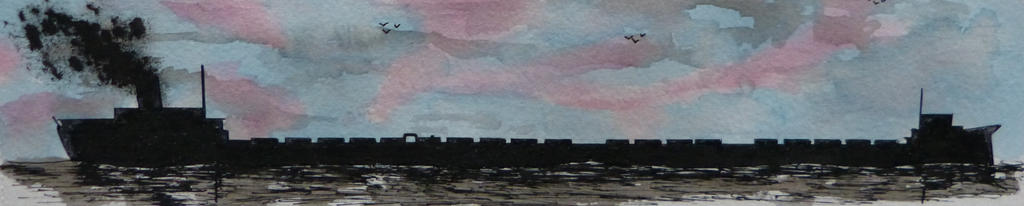
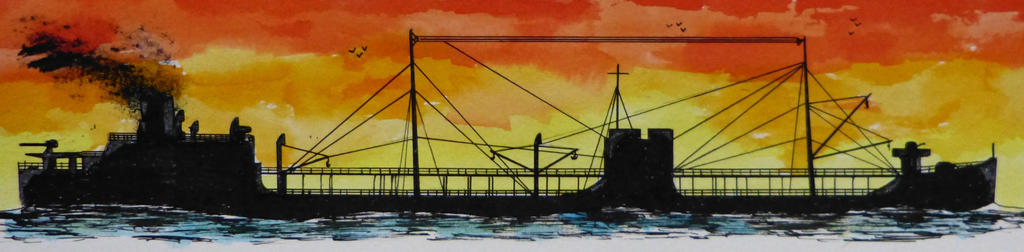
Dimensions 730.0 (over all) -712.0 (between perpendiculars) x 75.0 (beam molded) x 39.3 (depth molded side amidships) x 26.5 (keel draught maximum summer)-24,3 (keel draught (minimum winter)-25.6 (keel draight normal) and as displacement 33,320 F.W. (total summer displacement W..L., L.T.)-31,700 F.W. (total displacement normal W.L., W.T.) tons, 7,700 light ship (approximately L.T.) tons, 25,620 F.W. (total deadweight summer W.L., L.T.)-24,000 F.W. (total deadweight normal W.L., W.T.), crew, stores, 50%& Tank, L.T. 500, 25,120 F.W. (cargo deadweight summer W.L., W.T.)-23,500 F.W. (cargo deadweight normal W.L., W.T.) Fuel oil capacity 4,985 barrels. Potable water capacity 21,150 gallons. Reseve feed capacity L.T. 109.
Speed (normal) 16.0 miles. Number of cargo tanks/holds 4. Number of hatches 18. Approximately U.S. gross tonnage 10,500 tons and approximately U.S. net tonnage 6,300 tons. Cargo capacity (self-trial) 775,000 cubic feet, 24,000 maximum ore cargo 17 C.F./L.T. and 24,000 maximum ore conc. 22 C.F./L.T. Maximum coal cargo @45 C.F./L.T. 17,220. Maximum grain capacity @50 C.F./L.T 15,500 Figures at normal keel draught in salt water ad 36 cubic feet/long ton or in fresh water 36 cubic/long ton.
Source
The conversion of T2 tankers for Great Lakes and seaway service. The Society of naval architects and marine engineeers. Great Lakes Section. 1959.


No comments:
Post a Comment